I Was Once a Plant

I graduated from University of Guelph's Horticulture program in 2023 with a specialization in Natural Landscapes Management.
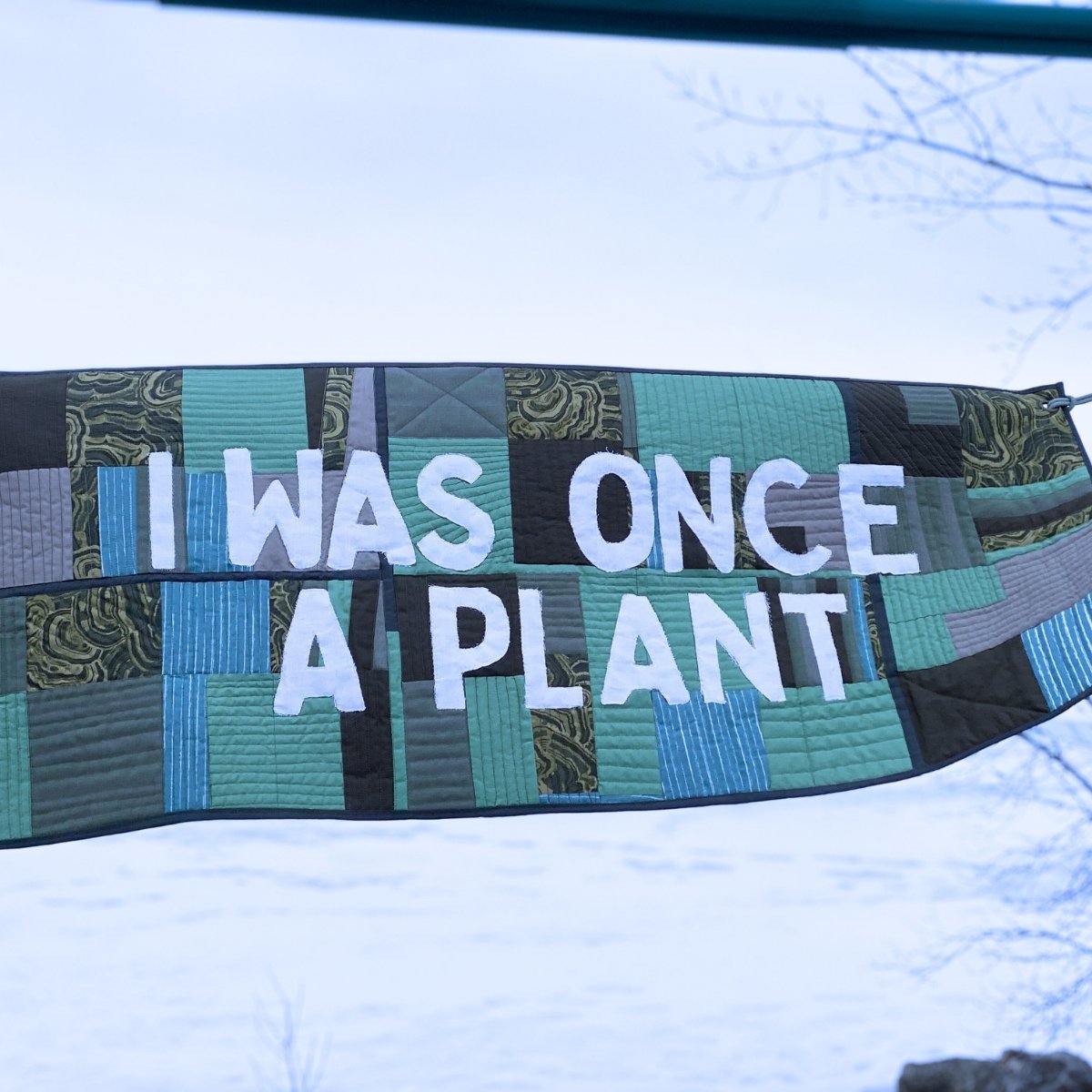
This banner was created for my certification's capstone assignment: the quilted banner explores our cellular connections to plants through traditional quilting techniques. It's my hope this banner can be a teaching tool used to demonstrate that quilting can actively participate in reducing human made climate change.
Artist's Statement
I am inspired by the long tradition of hand made, embroidered and quilted protest banners, sometimes called craftivism.
I used several styles of patchwork quilting to evoke an aerial view of farmlands. Using the visual language bold block letters seen at climate change rallies to declare in applique: I WAS ONCE A PLANT.
Clothing, banners - and quilting projects - are often made from cotton that is grown in environmentally intensive and destructive ways. It’s my hope this banner can be a teaching tool used to demonstrate that a centuries old craft - quilting - can and should actively participate in reducing human made climate change.
As I created this quilted banner I sought to reduce, reuse and recycle in every aspect of the process. I researched organic cotton types, found several suppliers and bought certified organic cotton that uses significantly less water in the growing and production of the textiles. The new textiles are all OEKO-TEX® Standard 100 certified printed cotton, the fabric and dyes have been rigorously tested for toxic materials.
I also used reclaimed materials. The lettering is cut from a 1960’s era tablecloth found at the bottom of a long forgotten linen chest. The dark green striped fabric are napkins, and the backing fabric and batting are all from a local thrift store.
This piece also owes specific credit to fiber artists Leah Evans, Alicia Merrett and the long lineage of mostly women who have sewn, quilted and embroidered countless magnificent aerial views and protest banners that came before this one.
The quilted banner seeks to reconnect the viewer with the wonder of plants, and remind them of the deep connection between textiles and horticulture.
Materials
100% Organic Cotton Poplin, OEKO-TEX® Standard 100 Certified
Found textiles from thrift stores and forgotten places
Dip Dyed Braided Cotton Cord, 3mm; Made in Canada with cotton from Mexico

2023 • Quilted banner, organic cotton prints • 84" x 48"
References
Binkovitz, L. (2013, April 26). At the Smithsonian Craftshow: Textile Topographies. Smithsonian Magazine; Smithsonian Magazine. https://www.smithsonianmag.com/smithsonian-institution/at-the-smithsonian-craftshow-textile-topographies-43184208/
Delate, K., Heller, B., & Shade, J. (2020). Organic cotton production may alleviate the environmental impacts of intensive conventional cotton production. Renewable Agriculture and Food Systems, 36(4), 405–412. https://doi.org/10.1017/s1742170520000356
Evans, L. (2015). Home | Leah Evans Textiles. Leah Evans Textiles. https://www.leahevanstextiles.com/
Merrett, A. (2020). Home Page. Aliciamerrett.co.uk. https://www.aliciamerrett.co.uk/
OEKO-TEX®. (2021, June 17). What OEKO-TEX® Labels Mean and Why They Matter. Oeko-Tex.com. www.oeko-tex.com/en/news/blog/what-oeko-tex-labels-mean-and-why-they-matter
Shade, J., & Delate, K. (2023). Organic Cotton: One of the most important choices you can make for the environment. https://www.organic-center.org/sites/default/files/publication_files/organiccottonenvironmentreport.pdf
Simpli Fabric. (2021). Poplin / Quilter’s Weight. Simplifi Fabric. https://www.simplififabric.com/collections/woven